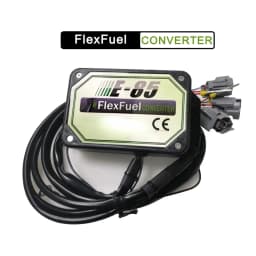
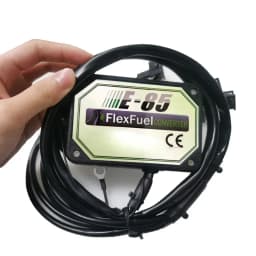

Ethanol Car E85,Cold Start Asst Flex Fuel Converter 3 Cylinders E85 Conversion Kit, 3CYL 4CYL E85 Biofuel Biothanol Converter
206.1$
127.78$
Quantity:
1
Availability:
Color
Cable Length
Ships From
Card Payments
Crypto Payments
Easy return
Reliable Shipping
S'il vous plaît noter avant d'acheter que nos kits sont compatibles avec l'injection indirecte électronique 12V typique (aspiration naturelle) ou Turbo essence véhicules fabriqués à partir de 1990 (non compatible avec K - Jetronic / injection directe GDI TSI... / carburateur / système hybride).
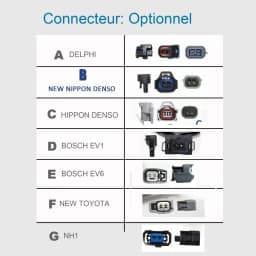
S'il vous plaît choisir le bon type de connecteur lors de la commande, ou envoyez - nous une photo du connecteur d'injection de carburant;
Le raccord d'injection de carburant est identique au 3 / 4 / 6 monté directement sur le moteur de la voiture.
Please note before purchasing, our kit is compatible with typical 12V electronic indirect injection (naturally aspirated) or turbo gasoline vehicles manufactured after 1990 (not compatible with K-Jetronic/direct injection GDI TSI.../carburetor/hybrid systems).
Please select the correct connector type when placing an order, or send us a photo of the fuel injection connector;
The fuel injection connectors are something the 3 / 4 / 6 same connectors, which are directly mounted onto the car engine.
Please follow the instructions in the picture to connect the wires
Please remember take the photos of your car fuel injection connector to us if you don't know how to choose which model
E85 conversion kit
1. with cold star
2.BUILT IN TEMP. SENSOR
3 4 Cylinders E85 Conversion Kit
E85 conversion kit 4cyl with Cold Start Asst. biofuel e85, ethanol car, bioethanol converter
E85 conversion kit 4cyl EV1 (plastic case) with Cold Start Asst.,
flex fuel conversion kits
fuel system conveter E-85
Regarding our Factory :
Shenzhen Autoptech Technology Co., Ltd is one of leading manufacturers of video surveillance, image signal processing, mobile DVR and CMS software in the world, providing global customers with high-quality products in the field of video surveillance, security and vehicle surveillance as well as customer-oriented services and solutions to create added value for customers by enhancing competitiveness and wide development in global market.
1. BUILT IN TEMP. SENSOR;
2. COLD START ASST / Cold Engine Starting Asst ;
3. 4, 6, 8 Cyl models with connector types;
4. CE approved and compliance with European directives
4. Good Quality, with industrial longest 5years' factory warranty ;
5. flex fuel ethanol alternative fuel with Competitive price;
Regard the Products:
E85 flex fuel ethanol alternative fuel allows gasoline only vehicles to run on ethanol as an alternative fuel.
flex fuel ethanol alternative fuel installs as a plug and play device in the vehicles fuel Injection system, by means of rerouting the signal from the E. C. M. to the fuel injectors.
We provide OEM manufacturing service for world distributors on E85 industry;
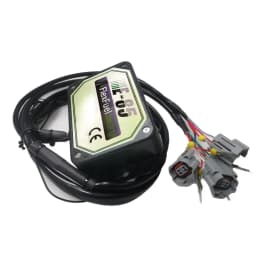
We offer full series e85 flex fuel ethanol alternative fuel, consist of3 Cyl models with connector types available for EV1, EV6, Nippon Denso, Delphi, Toyota and Honda.
flex fuel ethanol alternative fuelwith TRUE cold starting asst. technology and with built in temp. sensor. That kits will, of course, be easy for your engine cold start, when temp. drops below 10°C.
flex fuel ethanol alternative fuel are CE approved and compliance with European directives: EMC 2004/108/EC, EN55022: 2010, EN61000-3-2:2006+A1:2009+A2:2009, EN61000-3-3:2008, EN55024:2010
flex fuel ethanol alternative fuel with industrial longest 5years' factory warranty(5years' on circuit board and rest one year on other mechanical parts, such as harnesses and connectors)
Features
** flex fuel ethanol alternative fuel works on your vehicles OBD2 emissions and fuel mapping systems which creates an automated transition between gas and ethanol. Since the fuel map is automatically set for your vehicle, you just need to fill up with whichever mixture of ethanol and gas you choose.
** Better solutions to existing vehicles and also new and different technologies as auto manufacturers come out; compliance with Multi-Displacement System (MDS) gasoline engines.
** Low temp. Cold Engine Starting Asst.
** flex fuel ethanol alternative fuel has code that adapts itself to vehicles that drop cylinders for better fuel economy.
** flex fuel ethanol alternative fuel has code that watches for erratic, confusing signals and shuts down operation until problem disappears. This is a safety feature to prevent flooding.
** flex fuel ethanol alternative fuel has a new feature that stabilizes voltage signal to the microprocessor in case customer has high amp draw (big stereos, etc.)
Sample order is welcome . Please contact us with a quick reply .
We can offer 2 year warranty about this product.
Payment : TT W/U PA-YPA-L E85 conversion kit
Delivery Time 3 days for sample . 7-15 dya for bulk order.
FAQ:
** What is E85 Conversion Kit?
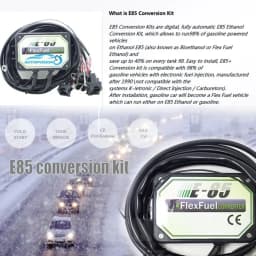
E85 Conversion Kits are digital, fully automatic E85 Ethanol Conversion Kit, which allows to run
98% of gasoline powered vehicles on Ethanol E85 (also known as Bioethanol or Flex Fuel Ethanol) and
save up to 40% on every tank fill. Easy to install, E85+ Conversion kit is compatible with 98% of
gasoline vehicles with electronic fuel injection, manufactured after 1990 ( not compatible with the
systems K-Jetronic / Direct Injection / Carburetors / Hybrid Vehicles ).
After installation, gasoline car will become a Flex Fuel vehicle which can run either on E85 Ethanol or
gasoline.
** Does my engine have to be in perfect condition? My vehicle has a lot of miles on it; is it too
worn out?
A successful ethanol conversion should start with a car that has been properly maintained and is
in good working order. High mileage is generally not a barrier so long as the car runs well. We
have customers who have converted high mileage cars with well over 200K miles and their vehicle
runs great on ethanol. But if your car is burning a lot of oil, has poor compression, runs poorly or
is hard to start, those issues need to be addressed before attempting conversion.
** I have an older car with high mileage. It runs well, but what things should I check to make
sure they are OK?
Rubber – If your vehicle is old enough, it may have rubber components in the fuel system. We
have found that if your vehicle was manufactured after 1990, it is probably free of rubber in the
fuel system. If you are converting an older vehicle, you will likely need to replace the fuel line and
the fuel pump with modern components. If your vehicle is newer than 1990 and it looks like it has
a rubber fuel line, it is most likely made from neoprene. Neoprene looks like rubber but it is not
reactive to ethanol and is fine.
Fuel Pump – The fuel pump needs to be delivering adequate pressure and flow. Stock OEM fuel
pumps generally deliver plenty of fuel for your engine even with it running E85. If your vehicle
can currently run well at full throttle, your fuel pump is probably in fine condition and will
probably not need replacing.
Fuel Filter – Gasoline contains olefins and waxy paraffin like compounds. Fuel vendors add
detergents to try and keep these in suspension but there is a tendency for them to deposit onto the
surfaces of your fuel system. Over time, the inside of your fuel tank can become lined with a
mixture of these compounds. Ethanol is very good at mobilizing these deposits and a few tanks of
E85 will do a good job of cleaning them from your fuel system. They burn well, especially when - 2 -
mixed with ethanol, and will not harm your vehicle to be removed from your fuel system in this
manner. The trouble is that these waxy compounds may also have been securing sediments to the
bottom of your fuel tank. When these sediments are no longer secured, they will find themselves
picked up by the fuel pump and into the fuel filter where they will start to obstruct the flow of fuel.
This problem is most common when budget fuels have been used over a long period of time but
most fuel filters are relatively easy to change. If you think you are a likely candidate for this issue,
we recommend using your first few tanks and then changing the fuel filter as a preventative
maintenance item rather than experiencing a problem when you are in a remote area.
Oxygen Sensors – Your vehicle will have one or more oxygen sensors. The oxygen sensors enable
your vehicle's computer to properly trim the fuel. The ability to adjust the fuel trim is standard on
all modern fuel injected engines and it is crucial that this system be working properly. If your car
is running well on gasoline, your oxygen sensors are probably OK. Occasionally we have seen
some older sensors get soft with age and use. If, after conversion, your engine runs well on
mixtures up to about 50% ethanol but you are having difficulty with higher concentrations of
ethanol, the problem may be due to oxygen sensors that are not responding as they should. If you
suspect you may be having this trouble, you can check the electrical response of the sensor. While
it is usually not necessary to do so, oxygen sensors are easily replaced should you experience this
issue.
** What model of converter do I need?
This will depend upon the type of fuel injection system you vehicle uses and the number of
injectors it has. The following are descriptions of each of these types. The one that matches your
vehicle will determine the model of conversion system you will need. If you have questions, please
contact our technical support for assistance.
Standard 12V Multi Port – Most vehicles fall into this situation. Locate the injectors and examine
the connectors. You may need to remove one from the injector to make a match as the outer
appearance will vary. The important consideration is the configuration of the mating parts. If
you are having trouble determining a match, send us a digital photo of the mating end of your
connectors and we will help with the identification. It is also important to verify the polarity of
your car's injector wiring. Each connector has a relatively standard way that it is wired but some
vehicles have it the opposite direction. The easiest way to do this is to examine the color code of
the injector wires going to several of your car's cylinders. There will be a pair of wires going to
each cylinder's injector and one wire from each set will usually have the same color code. This
will be the positive wire. If you cannot find a color code in common, you will need to use a volt
meter on the wires. The injection system can usually be energized by turning the key to the on
position. One of these wires will show a +12V potential over the chassis or negative battery
terminal. Note which side the positive wire is on when looking at the face of the female connector
as shown in the photos.
Buried injectors – late model V-6 engines will usually have the injectors buried under the air
plenum. Some plenums are easy to remove and some are much trickier. If you have a complicated
air plenum removal situation, you may wish to opt for the hardwire installation as the injector
wires are generally easy to access.
4V injection – We have discovered that a few injection systems on European models use 4 volts
instead of the usual 12. We have only encountered this system on some Volvo and Audi models
but are unsure if there are any others that also use 4 volt injectors. We are investigating a - 3 -
solution for this but our 12 volt converters will not work on these injection systems. If you have a
4 volt injection system and would like to be notified when we have a solution for you, please Email
us.
** Do I need to run special oil, or change it more frequently?
You should always use a grade of oil that meets or exceeds the engine manufacturers
recommendations. There is nothing about the nature of E85 that would normally require special
oils or to change them more frequently. If your driving habits are hard on oil, then you should use
a high grade oil and/or change it more frequently.
One of the things that can cause oil to require changing is a buildup of contaminants. The oil
filter should always be changed at every oil change and that will help to keep particulate
contaminants out of the oil but chemical contaminants will still accumulate. These contaminants
come from the blow-by. During the power stroke, hot combustion gases will leak past the rings
and valve seals. These gases are allowed to escape the crankcase through the PCV system but the
oil will trap many of the chemicals that are present in these gases. For example, sulfur in the fuel
will form sulfur oxides. These will gradually build up in the engine oil. When an engine is first
started and not yet warm, water vapor from the combustion will also enter the crankcase and
condense on the cold surfaces. The sulfur oxides combine with the water to form sulfuric acid.
The ethanol part of E85 has NO sulfur or any other elements that would form harmful oil
contaminants, so using E85 should reduce the rate oil becomes contaminated with such things.
Grit from the intake air can also enter your crankcase with the blow-by. Your choice of fuel will
not change the amount of grit that is in the intake air. You should change your air filter when
recommended or more frequently if you operate in dusty dirty conditions.
Oil dilution is rare, but can occur if an engine is running excessively rich. If your engine is in
good working order, this will not be a problem whether you are using gasoline or E85. Vehicles
from 1996 will have level 2 on board diagnostics that will detect a rich condition and alert you
with a check engine light.
Oil can breakdown due to heat and pressure between bearings. Converting a vehicle to E85 can
significantly increase its performance potential. If you make a habit of using this extra
performance, you are placing your engine into a situation which will more quickly cause the
engine oil to loose its lubrication. Note that this does not require street racing. If you find that
your SUV is able to pull your boat up the mountain pass 10 MPH faster than before, you are
spending an extended period of time with your engine at or near full-throttle. This is hard on
ordinary oils and if you read most owner's manuals, the manufacturer would classify towing as
hard service and recommend more frequent oil changes.
What do we use in the E85 kit Hummers? These vehicles are using a full synthetic oil.
First , the increase in fuel efficiency will often pay for the difference in the cost of the oil.
Second , we want our vehicles to stay in top shape and last a long time.
Third , while we don't drive like maniacs, we do pull trailers and use these vehicle's off-road
capabilities and want an oil that will keep the engines lubricated properly. We think it is a good
investment.
** I've heard that E85 will harm my engine. Is this true?
A definitive answer is, "it depends". The 1973 oil embargo caused fuel shortages and prices rose
dramatically. This spurred America to find both alternatives to gasoline and ways to extend the
fuel supply. One thing that was noticed was that an engine could burn a mixture of alcohol and - 4 -
gasoline and the resulting product was called gasohol. There were a few problems that were
encountered. First, the alcohol that was typically used was wood alcohol or methanol. Methanol
is much more corrosive to many common materials than is ethanol and unfortunately most of the
vehicles that were on the road in the 1970s were not designed to have alcohol in the fuel.
As a result, gasohol had a short duration on the market but congress was determined to reduce
America's dependence upon foreign oil. Tax incentives for the production of ethanol were
established and there were several executive orders to use gasohol in the vehicles that could safely
utilize it. In 1982, another fuel shortage occurred and it was obvious that alcohol blended fuels
were coming. The manufacturers changed the engineering of the vehicles to be more chemically
compatible with the presence of alcohol in the fuel.
Ethanol is a much better alcohol to use for fuel than methanol. For most materials, it is less
corrosive, it has considerably more energy, and is also far less toxic. For several years, it has
been common to blend ethanol into the gasoline supply. E10, a mixture of 10% ethanol and 90%
gasoline is available at many vendors. Blending a couple of percentage points of ethanol into the
gasoline is not only common practice, but in many areas it is being required.
What we have found is that if your vehicle was manufactured in 1990 or later, the fuel system and
engine were most likely made with materials that are not sufficiently reactive to ethanol to be a
problem using E85. If you have an older vehicle, you will need to investigate whether or not the
fuel system can use ethanol. The most common material that was a problem is rubber. If you use
E85 in a vehicle with rubber fuel system components, they will deteriorate fairly quickly and fail.
This could cause fuel leaks and result in a significant risk of fire. If in doubt, older vehicles
should have their fuel lines and fuel pumps replaced. Most auto parts stores should be able to
supply you with the parts necessary to make this change.
** Do I have to change my injectors?
We have found that the stock OEM injectors on late-model engines work fine with E85. Unless
you are building a race car and need a high performance injector, the ones your engine already
has should be OK. Ethanol is also an excellent cleaner and works to keep the injectors, fuel rails,
and valves free of deposits, so you also do not have to have your injectors cleaned. The ethanol
will do that for you.
** Do I need to change my oxygen sensors:
If your engine is running fine on gasoline, your oxygen sensors are probably working well and you
should not have to change them. Sometimes these sensors can be degraded through age and use
and will not respond as well as they should. In this unlikely event, your engine's computer will
have difficulty making proper fuel trim adjustments. If you convert to E85 and find that your
engine runs fine with ethanol mixtures up to about 50% but has difficulty with 85%, the problem
may be due to soft O2 sensors. A mechanic can diagnose whether this is the cause by examining
the electrical response of the sensors. If an O2 sensor is found to not be responding as it should,
they are easy to replace.
** Are there any other sensors that need to be added or replaced?
All of the sensors that your vehicle was equipped with need to be in good operating order if your
engine is to perform as it should. Some factory flex-fuel vehicles added an alcohol sensor to allow
the computer to determine the alcohol content of the fuel but that practice was discontinued by all
of the manufacturers of factory flex-fuel vehicles. Our conversion system does not require you to
add any sensors. All computer controlled fuel injection systems monitor the oxygen sensors to - 5 -
determine if the proper fuel to air mixture has been achieved and will adjust the fuel trim to
achieve the proper ratio. This allows the engine to adapt to varying fuel grades and prevents the
engine knocking that was so common with the carburetor based systems. Our converter extends
your engine's built in ability to trim fuel. By extending this fuel trim range, our converter allows
most vehicles to use any mixture of gasoline and ethanol without requiring any manual
intervention.
** What is the octane rating of E85?
There are, of course, several variables such as the exact mixture of ethanol in the gasoline and the
grade of gasoline used but E85 should result in an effective octane of approximately 105. It is
very resistant to pre-detonation (knocking) and works very well in high compression engines.
** How much will my MPG be affected?
There are a lot of variables here. Ethanol has less chemical energy per gallon than gasoline. It
burns more efficiently however, so while you will get fewer miles per gallon, you will get more
miles per BTU. The increase in the burn efficiency will partially offset the difference in the energy
levels of the two fuels.
Driving habits have a large impact on fuel economy. Running on E85 generally results in a
noticeable increase in performance. If you make a habit of using the extra performance, you
should not expect it to have a positive effect on your MPG.
This is definitely one of those "results will vary" situations. Our customers have reported MPG
differences generally ranging from 5% to 20% lower for E85 than when running on gasoline.
Other than driving habit changes, the most common factor seems to be that the higher the engine's
compression ratio, the less the mileage loss. We have customers who claim their Toyota Prius will
get essentially the same mileage on E85 as it did on gasoline.
If you are driving conservatively in an average car, you will probably see a 15 to 20 percent loss
in mileage. If you are on the high end of the MPG loss of approximately 20%, then to achieve the
same cost per mile, you should look for a 20% price differential between gasoline and E85. If the
regular grade of gasoline is selling for 3.00 per gallon, you need a 60 cent differential in price
and would look for E85 selling for 2.40 or less. In areas where E85 is readily available, there is
often more than a 60 cent difference in the pump price.
Due to the high octane rating of E85 (approximately 105), it is an excellent alternative to buying
premium for high performance engines. Premium is often 20 cents or more above the price of
regular. If your engine needs premium, converting to E85 will be an even more attractive option.
** Can I use pure ethanol?
In the US, the answer is no unless you want to pay the beverage tax. The highest concentration of
ethanol that the US allows in fuel grade ethanol is 98%. The other 2% is gasoline, thus rendering
it unfit for drinking but doesn't really change it's combustion characteristics. In 2007, the Indy
500 used this fuel. It has an octane of 120 and the performance you can achieve is phenomenal,
especially in high compression, turbo, or supercharged engines.
It is difficult to find E98 for retail sale but is the concentration that will be loaded onto trucks
when the ethanol leaves the production facility. If you don't want to brew and distill your own
fuel, you will need to talk to an ethanol distributor or blender to obtain E98. If you are running a
race car and are paying for 105 octane gasoline, you will want to take a serious look at
converting to E98. With this high an ethanol content in your fuel, you will want to adjust your
converter to a higher setting, probably in the 8 to 10 range. This will enable easier starting and - 6 -
maximum power.
For the average individual running an ordinary vehicle, the performance difference between E85
and E98 is probably not worth the trouble but with our conversion box, you can do so if you wish.
We have tested E98 in both of our Hummers and in a 2003 Dodge Dakota with a 4.7 liter V8. The
power increase is remarkable but remember, you didn't upgrade your transmission... Driving
hard is hard on the equipment.
** I've heard that it can be hard to start your vehicle on E85 in cold weather.
Some vehicles have more trouble with this than others but in general, it is true, even of factory flex
fuel vehicles. Most of the reason has to due with the nature of the fuel. It is harder to start a cold
engine on ethanol. The higher the percentage of ethanol, the sooner this will become an issue.
During the winter time especially below 15F is the most problem to burn ethanol. Thanks to our smart
engineer that has developed the most advance E85 conversion kits in the market which allow to burn
ethanol even at cold winter time. Our kit with built in temperature sensor; when the outside temperature
drops below 13°C, our e85 Flex Fuel Converter cold start feature will turn on but only during the initial
starting cycle. It will add extra fuel during the starting cycle to help increase the vaporization potential
allowing for a considerably easier engine start.
One of the reasons you won't normally see a blend of ethanol beyond 85 percent is that the 15% of
gasoline helps with engine starting. Most E85 vendors in colder climates will down blend the
product during the winter to approximately 70% content. In fact, if you read the fine print on
some of the pumps, it will say, "Contains a minimum of 70% ethanol." This is a good thing since
at 70% ethanol, cold starting issues generally disappear.
Fuel Trim – having the correct fuel mixture when starting is a big advantage. Many of the newer
vehicles will remember the trim they were using when last shut off. If you have a vehicle that
remembers its fuel trim, you will have fewer cold start issues. If your vehicle does not remember
its trim, it must make some average assumptions, start the vehicle, and wait for the oxygen sensors
to reach approximately 600 degrees before it can adjust the fuel trim. We suggest to trim its fuel in
approximately 45 seconds from a 60 degree (F) start.
Converter adjustment – To have the ability to run either fuel without opening the hood and making
adjustments, you can adjust the converter to 6 (see adjusting the converter). This setting
works well for most vehicles and allows the vehicle's fuel trim system to trim lean enough to run
with gasoline and to trim rich enough to run E85, just by watching the oxygen sensors. Since E85
is not always available, it is important to be able to do this. If you always run E85 and are having
some cold start issues, you can adjust the setting inside the converter to a higher (richer) setting.
If you set it on 10, cold start problems will probably disappear but you will also probably get a
check-engine light with a rich condition if you should run gasoline. If this happens, it will not
harm your engine. Simply readjust to a lower setting. Once the rich condition is corrected, the
check-engine condition should clear on its own.
** Why is an engine harder to start on ethanol?
Vapor Pressure – The first difference in these fuels is that ethanol has a lower vapor pressure
than gasoline. This means that while the cylinder head is below the boiling point of ethanol,
gasoline will more readily vaporize. Since there is very little time from when the injector squirts
the fuel to when the spark plug will attempt to ignite it, this can make for significantly less of the
ethanol to have turned into a vapor than would have happened for the same amount of gasoline.
Liquid fuels do not burn. To compensate for this, all engines will add extra fuel when starting as - 7 -
it is the fuel to air mixture OF THE VAPOR that matters.
Carbon-Carbon Double Bonds – Gasoline ignites more easily than ethanol. There are
fundamental differences in the physical chemistry of these fuels. In order to start and then
maintain a combustion chain reaction, you must have fuel as a vapor well mixed with oxygen and
have sufficient kinetic energy (heat) in the molecules to destroy the existing molecular bonds in the
fuel and reform bonds with the oxygen. Double bonds are easy places for an oxidizer to attack a
fuel molecule. Because the double bond is easy to attack, it lowers the energy required to break
the first bond when a fuel contains a double bond. Additionally, when conditions for combustion
are marginal, the presence of double bonds in the fuel will enable combustion when it would
otherwise not occur.
Gasoline – Gasoline is mostly a mixture of various alkylates, all of which contain a double bond.
This prevalence of double bonds in the molecules of gasoline results in a low flash point. It is easy
to ignite and is not very picky about the fuel-to-air mixture in order to maintain combustion. Of
course clean combustion requires a correct mixture, but to have combustion at all (and get the
engine started) you need only be remotely close.
Ethanol – Ethanol, C2H5OH, has no double bonds whatsoever. There is no easy attack point.
For an oxygen to steal away any part of this fuel, it has to have significant energy or it will fail to
break any of these bonds. Because of this, in order to have combustion, the conditions for must be
closer to ideal than for gasoline with its abundant double bonds. Even with 15% gasoline, E85
has a much lower concentration of double bonds and is therefore harder to ignite. Increasing
gasoline content to 30% provides an adequate concentration of double bonds to assist in
sustaining combustion when conditions are poor. This is why you will often see a 70% blend
during cold winter months.
Customer Reviews
No reviews yet
Ethanol Car E85,Cold Start Asst Flex Fuel Converter 3 Cylinders E85 Conversion Kit, 3CYL 4CYL E85 Biofuel Biothanol Converter
206.1$
127.78$
Quantity:
1
Availability:
Color
Cable Length
Ships From